
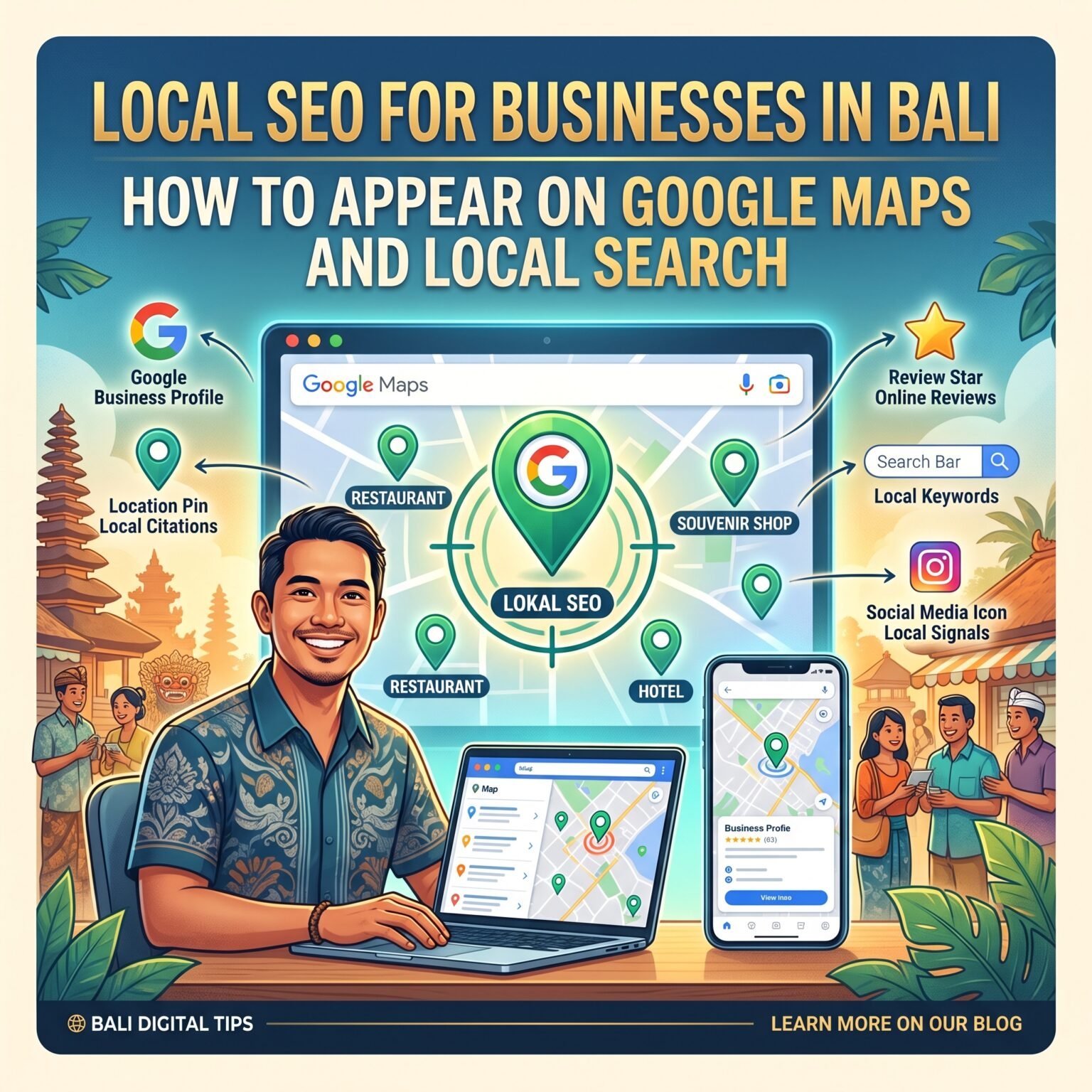
Picture someone walking around Canggu, hungry, typing “restaurant near me” into Google. Five results pop up — and your business isn’t one of them. The food is great, the service is warm, the location is convenient. The problem isn’t the product. It’s visibility in local search.
This is a reality for countless local businesses in Bali — restaurants, villas, beauty clinics, service providers, fitness studios. They’re not just competing with similar businesses nearby; they’re competing against an ocean of tourism content and major news coverage that dominates anything containing the word “Bali.” This is exactly where local SEO becomes the underused advantage that directly affects how many customers walk through the door.
What Is Local SEO, and How Is It Different From Regular SEO?
General SEO focuses on improving a website’s ranking for topics and keywords broadly. Local SEO is more specific: it’s about making sure your business shows up when someone searches for something near their current location — whether through “near me” keywords or directly on Google Maps.
Local SEO combines three main elements: Google Business Profile optimization, consistent business information across platforms, and local trust signals like customer reviews.
Why Local SEO Matters Especially for Bali Businesses
Bali presents a unique challenge: any keyword containing “Bali” is dominated by tourism content, news coverage, and even MotoGP-related content — not small and medium local businesses. That makes national-level organic ranking far more competitive than in most other cities.
The good news: local SEO plays on a smaller, fairer field. Both tourists and locals are used to searching with phrases like “near me” or opening Google Maps directly when deciding where to eat, stay, or find a service. If your business profile is properly optimized, you can compete within your local radius without needing to win a much harder national ranking battle.
Core Components of Local SEO You Need to Get Right
1. A Fully Optimized Google Business Profile (GBP)
This is the foundation. Make sure your business category is accurate, opening hours are correct, photos are high-quality and up to date, and your business description includes relevant local keywords. A complete, active profile is far more likely to show up in the “Local Pack” — the top three results that appear on Google Maps.
2. NAP Consistency (Name, Address, Phone Number)
Your business information needs to match exactly across every platform — Google Business Profile, your website, Instagram, online directories. Even small inconsistencies, like a slightly different address format, can confuse Google’s algorithm about your location’s legitimacy.
3. Local Keyword Optimization
Don’t just target generic keywords like “pilates studio.” Get specific with location: “pilates studio Jimbaran” or “villa near Sanur beach.” These hyper-local keywords are easier to rank for and far more relevant to searchers who are already close to making a decision.
4. Review and Rating Management
Google reviews are one of the strongest trust signals — both for the algorithm and for prospects reading them directly. Ask satisfied customers to leave a review, and respond to every review, including negative ones, professionally and promptly.
5. Local Backlinks and Citations
Being listed in local business directories, mentioned by Bali community media, or referenced by other local business partners helps reinforce to Google that your business genuinely operates and is relevant in that location.
6. On-Page Signals That Support Location
Embed a Google Map on your contact page, create a clear “Our Location” page, and make sure your website is mobile-friendly — since most local searches happen on smartphones while people are out and about. This technical side is part of the on-page SEO optimization we handle through our website development service.
A Practical Checklist You Can Start Today
- Review and complete your Google Business Profile — category, hours, recent photos
- Make sure your name, address, and phone number match across every platform
- Add at least one local keyword (your neighborhood/area name) to your GBP description and website
- Send a review link to your last 5 happy customers
- Reply to every unanswered review on Google
- Make sure your address and map are clearly visible on your contact page
Common Mistakes Local Businesses Make
- Leaving Google Business Profile untouched after the initial setup.
- Mismatched address or phone number across the website, Instagram, and Google.
- Ignoring negative reviews entirely, even though other prospects read them too.
- Focusing only on national-level SEO when the actual target audience is customers nearby.
If any of this sounds familiar, it’s often tied to broader website visibility issues too, not just local search. We cover that in more depth in Why Isn’t Your Business Website Showing Up on Google? 7 Common Reasons.
Local SEO vs Google Ads: Do You Have to Choose?
This question comes up a lot, and the answer isn’t either/or. Local SEO builds long-term organic visibility, while Google Ads delivers instant results while that SEO foundation is being built. Combining both is often the most efficient strategy for local businesses. We go deeper into this comparison in Google Ads vs SEO: Which Is Right for Your Business?
How Sentris Can Help With Your Local SEO
Local SEO requires ongoing consistency and a fair amount of technical detail to manage well alongside running daily operations. Sentris Communication offers tiered SEO packages — from a technical website audit and Google Business Profile setup at the entry level, to broader keyword research and optimization, up to link building and a regular content strategy at the more intensive level — matched to your business’s scale and growth goals.
If you want to figure out which package actually fits where your business is right now, reach out to our team for a free consultation — we’ll help map it out before you commit to anything.
FAQ: Local SEO for Bali Businesses
How long does it take to see local SEO results? Typically 2–4 months to start seeing changes in the Local Pack, depending on competition level in your area and category. Local SEO usually moves faster than national SEO since the competition is geographically limited.
Is local SEO just about Google Maps? No. Google Maps is the most visible part, but local SEO also covers website optimization, reviews, and citations across other platforms — all reinforcing your location signal together.
I run a small business without a physical storefront — do I still need local SEO? Yes, especially if you serve a specific area (like a mobile service that comes to the client). Google Business Profile can still be optimized using a “service area business” setting.
Can local SEO work alongside Meta Ads or Google Ads? Absolutely, and they complement each other well — ads bring instant traffic, while local SEO builds long-term organic visibility with no cost per click.
Want your business to be the first result people see when nearby customers search for what you offer? Start with a free consultation with the Sentris team.
Read more digital marketing strategy articles on the Sentris Communication blog.