
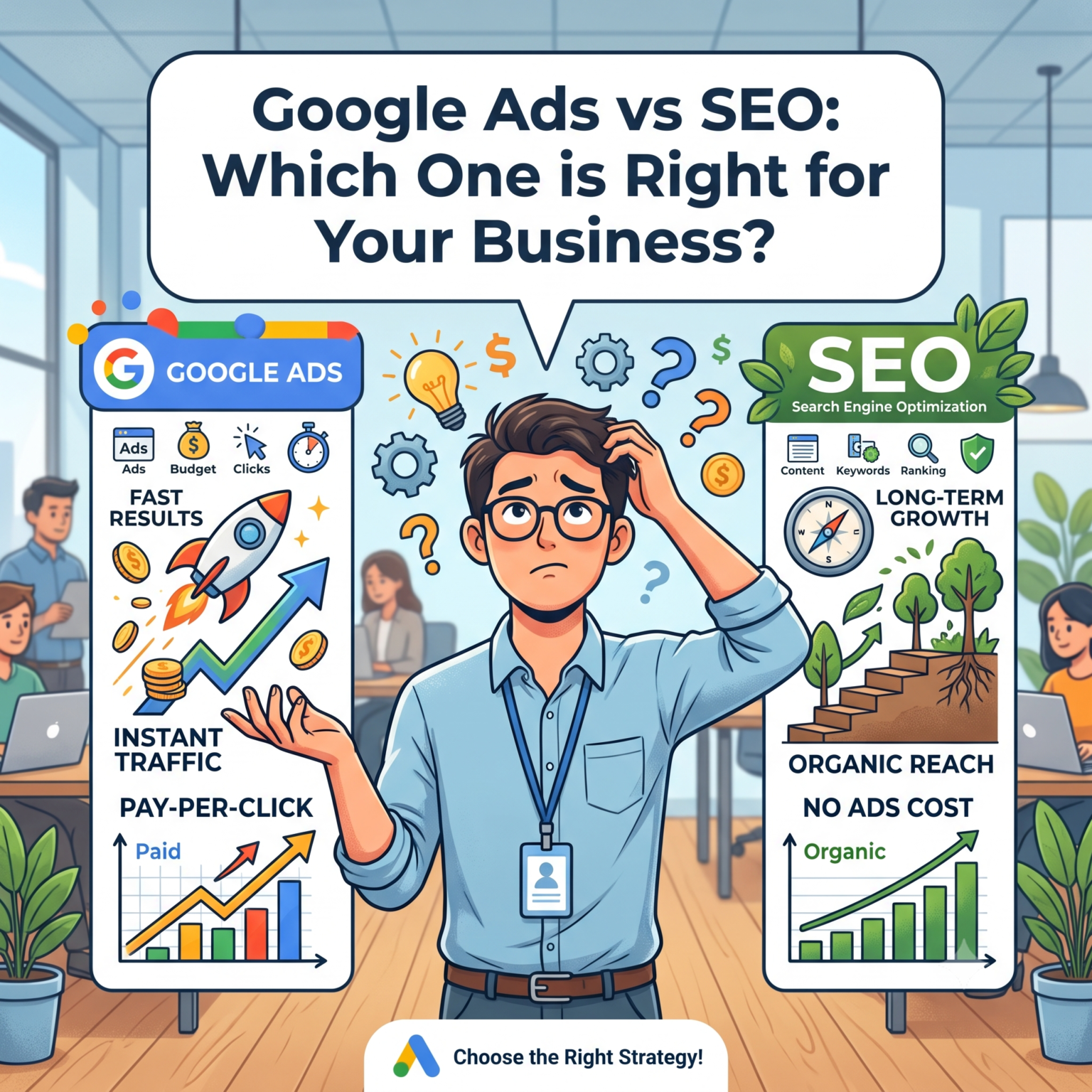
Marketing budgets are tight, yet everyone insists both Google Ads and SEO are “essential.” One client once told us, “If I only have a few million rupiah a month, should I put it all into Ads for instant results, or start SEO now?”
There’s no one-size-fits-all answer. But once you understand how each channel actually works, the decision gets a lot clearer. Here’s the breakdown.
What SEO is and how it works
SEO (Search Engine Optimization) is the process of getting your website to appear organically — without paying per click — in Google’s search results. It relies on technical website optimization, content that matches what your potential customers are actually searching for, and trust signals like backlinks.
SEO results aren’t instant. It typically takes weeks to months before Google fully “trusts” your pages enough to rank them for competitive keywords.
What Google Ads is and how it works
Google Ads are paid listings that appear at the very top of search results, marked with a “Sponsored” or “Ad” label. You pay each time someone clicks your ad (the Pay-Per-Click model), and results can show up within hours of launching a campaign.
Once the budget runs out or the campaign is paused, that visibility disappears immediately — unlike SEO, whose effects tend to last even after you stop actively “paying” for that ranking.
Comparing speed of results
This is the sharpest difference between the two. Google Ads can bring in clicks and leads on day one of a live campaign — ideal when you need bookings or sales quickly. SEO typically doesn’t show meaningful traffic until 3-6 months of consistent work, depending on how competitive your industry is and your website’s current state.
If your business needs momentum fast — say, an upcoming holiday season — Google Ads is simply more realistic than hoping SEO “catches up in time.”
Comparing long-term cost
On the other hand, Google Ads costs scale linearly — the more clicks you want, the more you keep paying, indefinitely. Stop paying, and the traffic stops too.
SEO follows a different cost pattern: the upfront investment (research, technical fixes, content production) is heavier, but the organic traffic you build keeps flowing without a per-click cost. Over a 12-24 month horizon, many businesses find their cost-per-visitor from SEO ends up significantly lower than from Ads.
When to prioritize SEO first
- Your business is playing a long game, not just chasing this month’s results
- Your industry isn’t extremely competitive in organic search
- You want to build a digital asset whose value holds up even if the ad budget gets cut
- You can afford to wait for gradual, compounding results
When to prioritize Google Ads first
- You need leads or sales soon (an event, a promotion, peak season)
- You just launched and your website has no track record with Google yet
- You want to test which keywords actually convert before committing serious budget to ranking for them organically
- Competitors already dominate organic results and would be hard to outrank anytime soon
Why it doesn’t have to be either/or
In practice, the two channels complement each other rather than compete. Data from Google Ads — which keywords actually drive conversions — can guide a much more targeted SEO content strategy. Meanwhile, organic visibility from SEO makes your brand feel more credible to prospects who’ve already seen your ads; people tend to trust a business more when they see it show up in both places, not just one.
When budget is genuinely tight, the approach we often recommend to Sentris clients is: start with Google Ads for quick momentum and keyword validation, while building your SEO foundation in parallel (technical fixes, core content) — an investment that pays off fully a few months later. Once SEO gains traction, some of that Ads budget can shift toward more specific keywords or retargeting.
Bottom line
There’s no single “better” channel — only the one that fits your goals, timeline, and current budget. If you’d like help mapping out the right combination for your specific situation, Sentris Communication regularly designs strategies that blend both in a measured way, rather than picking one at random. Reach out for an initial consultation.